
About Emeka Okereke
Transdisciplinary artist, philosopher and systems designer
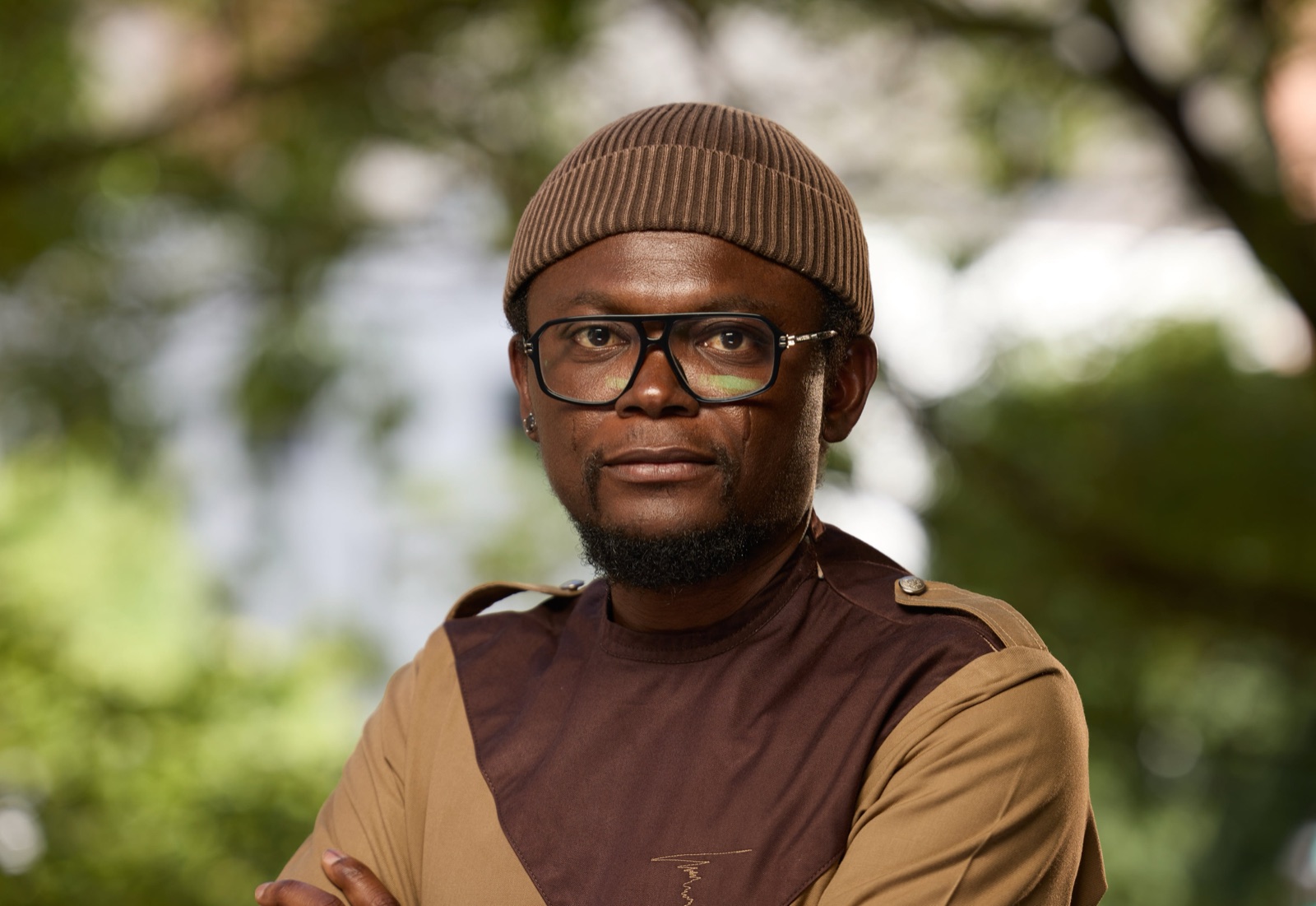
Emeka Okereke is a transdisciplinary artist, philosopher and systems designer whose practice takes image-making and photography as a point of departure while moving through writing, film, sound, poetry, conversation, pedagogy, installation, digital media and collective platforms. Based in Berlin and working across recurring points of movement between Africa and Europe, his work is animated by questions of perception, distance, encounter and relation.
Born in Aba, southeastern Nigeria, Okereke arrived in Lagos in 2001. Nigeria had recently emerged from decades of military dictatorship, and photography was becoming an increasingly vital language for artistic experimentation, social commentary and public engagement. Through his encounter with photographer and educator Uche James Iroha, and subsequently with the photography collective Depth of Field, he entered an ecosystem of image-makers who understood the camera as more than an instrument of documentation.
Okereke dates the beginning of his artistic career to 2002. Photography gave him an early language for approaching the world: a way of attending to light, bodies, distance and the conditions of an encounter. He has described it as the form through which he became available to the gift of perception. Yet the camera also produced movement. To make images was to leave a fixed position, enter unfamiliar spaces and bring the body into contact with realities beyond its immediate frame.
His participation in the Bamako Encounters in 2003 marked an early movement into a wider African and international artistic field. Residencies and studies subsequently took him to Europe, culminating in his education at the École Nationale Supérieure des Beaux-Arts de Paris from 2005 to 2008.
Moving between Africa and Europe intensified questions already present in the photographic work. Borders became tangible not only as geopolitical lines, but as administrative, perceptual and embodied conditions. Okereke began to describe himself as a “border being”: someone inhabiting more than one place and negotiating the distance between different worlds. Over time, however, the work moved beyond the articulation of identity. What became central was the relation between positions—the unstable interval in which projections arise, boundaries are felt and the certainty of separation begins to falter.
In 2009, this enquiry assumed a collective form through the founding of the Invisible Borders Trans-African Project. Its initial impetus was a journey by road from Lagos to the Bamako Encounters, undertaken by a group of Nigerian photographers and artists. But the project grew from a deeper conviction: that there is no life without movement, and that movement can offer a way beyond the stagnation of inherited narratives and imposed limits.
The road became an artistic method. Travelling across national borders exposed participants to uncertainty, improvisation, bureaucracy, hospitality and encounters that could not be predetermined. The image was no longer treated as the sole objective of the journey, but as an emanation of lived experience. The presence and transformation of the artist became as consequential as the photograph, film or text that followed.
Across successive journeys within Africa and extending into Europe and Asia, Invisible Borders developed into a platform for photography, film, writing, research, workshops, exhibitions and collective enquiry. It also transformed Okereke's understanding of artistic practice. The artist could create not only objects, but structures through which other people might move, exchange knowledge and generate work of their own.
This movement between individual practice and collective structure has become central to Okereke's trajectory. Photography remains foundational, but the enquiry has continued through Borderbeing, his literary and philosophical platform; films and installations; Nkata Podcast Station, where listening and conversation become artistic and pedagogical forms; and Footprints — Parable of the Sojourner, a living poetry anthology conceived through mobile digital technology.
Teaching, convening and cultural production have developed from the same grounding. Across universities, workshops, critiques and informal encounters, Okereke approaches pedagogy as a form of orientation: creating conditions through which others can locate their questions and develop their own ways of moving through the world. Systems design, in this context, is not separate from artistic creation. It is the making and tending of structures through which an idea, encounter or creative process can emerge, circulate and continue beyond the person who initiated it.
More than twenty years into his practice, Okereke understands these works as interconnected enactments rather than separate projects or disciplines. Their forms change according to what the enquiry requires. They return and transmute because relation itself remains in movement.
This is what he describes as the aesthetics of the iterative: the practice of returning without returning as the same person. The resulting photographs, films, writings, conversations, platforms and pedagogical encounters are not conclusions. They are temporary bearings—ways of sensing, questioning and remaining responsive to the world.
At the present stage of his work, Okereke is increasingly concerned with what becomes possible when creation proceeds from a trust in the innocence of the heart—when the work has no predetermined position to defend and nothing it must prove. From this ground, art becomes orientation: a movement towards encounter, relation and stewardship.
Fields of Recognition
Selected contexts in which the work has been presented, taught, published, supported and recognised.
Exhibitions and institutions
-
Neuer Berliner Kunstverein (n.b.k.), Berlin
Nkata Podcast: Art & Processes — an Exhibition of FiVE Conversations, within the group exhibition A Home for Something Unknown 2024
-
I Wonder As I Wander: On Akinbode Akinbiyi, shown within Akinbode Akinbiyi’s retrospective Six Songs, Swirling Gracefully in the Taut Air 2020
-
12th Rencontres de Bamako — a multimedia installation, an open-air cinema presentation and a poster exhibition in public space 2019 — 2020
-
Salzburger Kunstverein, Salzburg
Exploring a Void — a solo presentation of nine works, within Séamus Kealy’s 20 Propositions 2018
-
Centre Pompidou, Paris
Collective Intelligence 2017
-
All The World’s Futures — the Invisible Borders Project (The Trans-African Worldspace), in the international exhibition curated by Okwui Enwezor 2015
-
The Ungovernables — New Museum Triennial, with Invisible Borders 2012
Teaching and research
-
Hartford Art School MFA in Photography, University of Hartford
Guest lecturer and critic, in Berlin, San Francisco and Hartford 2017 — 2025
-
Berlin University of the Arts (UdK), Berlin
Exploring a Void — a semester course, twice 2022 — 2024
-
African Studies Program, Indiana University Bloomington
Visiting Scholar, held with the Eskenazi Museum of Art 2022
-
Berlin University of the Arts (UdK Berlin)
Lecturer, Interdisciplinary Artistic Practice and Theory, Studium Generale — Exploring a Void 2018
Honours and fellowships
-
National Geographic Society
Explorer 2022
-
Vera List Center for Art and Politics, The New School
Jane Lombard Fellow, for Invisible Borders 2020 — 2022
-
French Ministry of Culture
Chevalier de l’Ordre des Arts et des Lettres 2018
-
Bamako Encounters, Mali
Best Young Photographer 2003
Writing and publishing
-
The Routledge Companion to Global Photographies
Photography & Trans-Africanism: A Story of Journeys 2024
-
The writing platform: the enquiry thought in words 2008 —
Curriculum Vitae
A selected institutional record: education, roles and platforms, exhibitions, teaching, lectures, writing, awards and residencies. In English and in German.
Press and conversations
Selected profiles, interviews and recorded conversations by other people.
External biography Emeka Okereke on Wikipedia